SKIP TO CONTENTS
SKIP TO CONTENTS
PROBLEM STATEMENT
AI is becoming young adults’ no.1 tool for mental health advice — but usage is a risk to their wellbeing.
PROBLEM STATEMENT
AI is becoming young adults’ no.1 tool for mental health advice — but usage is a risk to their wellbeing.
Everyday anxiety is highly prevalent among young people, while professional support is often hard to access.
In this gap, AI chatbots have become an immediate source of coping and advice: cheap, easy to use, always available, and seemingly empathetic.
Everyday anxiety is highly prevalent among young people, while professional support is often hard to access.
In this gap, AI chatbots have become an immediate source of coping and advice: cheap, easy to use, always available, and seemingly empathetic.

In 2025, 13.1% of US young adults used AI regulary for mental health advice. Numbers are rising steadily.
In 2025, 13.1% of US young adults used AI regulary for mental health advice. Numbers are rising steadily.
REDESIGNING AI SYSTEMS AND INTERACTION
Cope is a speculative design concept that challenges problematic AI chatbot patterns in youth mental health.
By rethinking how an LLM responds to user distress, Cope fosters sustainable coping skills and builds long-term psychological resilience rather than digital dependence.
Cope is a speculative design concept that challenges problematic AI chatbot patterns in youth mental health.
By rethinking how an LLM responds to user distress, Cope fosters sustainable coping skills and builds long-term psychological resilience rather than digital dependence.
REDESIGNING AI SYSTEMS AND INTERACTION
Cope is a speculative design concept that challenges problematic AI chatbot patterns in youth mental health.
By rethinking how an LLM responds to user distress, Cope fosters sustainable coping skills and builds long-term psychological resilience rather than digital dependence.
Process
Process
Multi-perspective research
Multi-perspective research
Interviews with psychologists, therapists, and young adults were conducted to understand the nuances of AI usage for mental health, focusing on subclinical anxiety as a core use case.
Interviews with psychologists, therapists, and young adults were conducted to understand the nuances of AI usage for mental health, focusing on subclinical anxiety as a core use case.

Combining three perspectives to lay the basis of the project
Combining three perspectives to lay the basis of the project
Key AI patterns that increase anxiety
Key AI patterns that increase anxiety

Sycophancy increases reassurance-seeking

Immediate relief through instant messaging increases avoidance behavior

Engagement loops increase dependency and reduce autonomy
Sycophancy increases reassurance-seeking
Immediate relief through instant messaging increases avoidance behavior
Engagement loops increase dependency and reduce autonomy
Opportunity: coping skills as a key factor to anxiety prevention
Opportunity: coping skills as a key factor to anxiety prevention

Building, testing and co-developing
Building, testing and co-developing
The process was focused on defining new design principles and interaction patterns that focus on positive outcomes for mental health.
The process was focused on defining new design principles and interaction patterns that focus on positive outcomes for mental health.

Iteratively defining core design patterns

Gathering feedback on interactions and tone of voice via user testings
Iteratively defining core design patterns
Gathering feedback on interactions and tone of voice via user testings
Solution
Solution
Considering user intention from the start
Considering user intention from the start
Whether a user needs to find a solution, reflect on a situation, or simply talk through a feeling, the conversation path and the AI's tone adapt specifically to that goal.
Whether a user needs to find a solution, reflect on a situation, or simply talk through a feeling, the conversation path and the AI's tone adapt specifically to that goal.

Homescreen with optional conversation goal settings
Homescreen with optional conversation goal settings
Socratic dialog over instant answers
Socratic dialog over instant answers
Much time has been spent defining Copes tone of voice and response logic. To generate answers, Cope uses four validated theories in psychology.
Much time has been spent defining Copes tone of voice and response logic. To generate answers, Cope uses four validated theories in psychology.
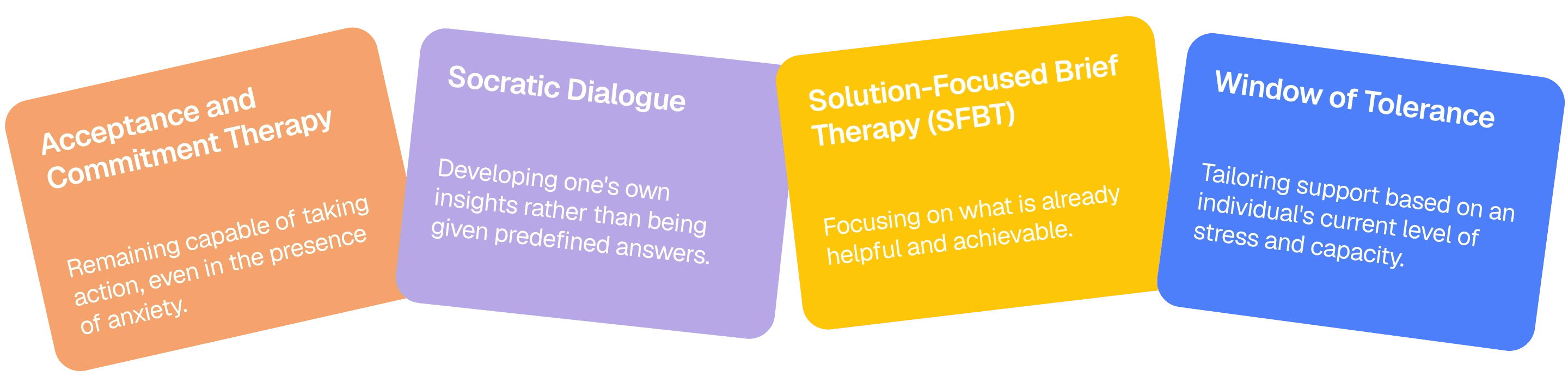
Four theories Cope uses that shape conversation, tone of voice, building coping skills and overall basis of the tool.
Four theories Cope uses that shape conversation, tone of voice, building coping skills and overall basis of the tool.
Instead of prescribing immediate solutions, Cope’s response logic utilizes socratic questioning. This guides users to uncover their own insights rather than relying on an external system. This approach directly counters the intolerance of uncertainty and loss of autonomy caused by standard AI models.
Instead of prescribing immediate solutions, Cope’s response logic utilizes socratic questioning. This guides users to uncover their own insights rather than relying on an external system. This approach directly counters the intolerance of uncertainty and loss of autonomy caused by standard AI models.

Example of questions for the user during conversations
Example of questions for the user during conversations
Avoiding dependence via non-permanent chat
Avoiding dependence via non-permanent chat
Unlike standard linear chat feeds that invite endless scrolling and re-reading, Cope’s chat interface is ephemeral. Once a session ends, the raw chat history vanishes. Removing persistent chat logs discourages reassurance-seeking habits and co-dependent interaction patterns.
Unlike standard linear chat feeds that invite endless scrolling and re-reading, Cope’s chat interface is ephemeral. Once a session ends, the raw chat history vanishes. Removing persistent chat logs discourages reassurance-seeking habits and co-dependent interaction patterns.

Linear, ephemeral chat interface
Linear, ephemeral chat interface
Context-aware coping exercises
Context-aware coping exercises
Cope integrates a database of clinically validated coping strategies. When relevant, the system suggests tailored exercises directly within the conversation—ranging from text-based reflection and interactive prompts to physical real-world activities.
Cope integrates a database of clinically validated coping strategies. When relevant, the system suggests tailored exercises directly within the conversation—ranging from text-based reflection and interactive prompts to physical real-world activities.

Concluding and recommending suitable interactive exercises based on user input

Interface adapts to different interactive modules within exercises
Concluding and recommending suitable interactive exercises based on user input
Interface adapts to different interactive modules within exercises
Full user control over saved data and Insights
Full user control over saved data and Insights
Users can consciously save meaningful insights, realizations, or helpful exercises during or after a session. These saved elements build self-awareness, allowing users to recognize their personal coping patterns over time.
Users can consciously save meaningful insights, realizations, or helpful exercises during or after a session. These saved elements build self-awareness, allowing users to recognize their personal coping patterns over time.

Quick access to save insights at any point during an interaction
Quick access to save insights at any point during an interaction

Insight collection is a positive space that reminds users of their process
Insight collection is a positive space that reminds users of their process
Building personalized coping toolbox
Building personalized coping toolbox
Saved insights and successful strategies are stored in a personalized Coping Toolbox. Designed as a modular reference bank, the toolbox helps users execute coping strategies autonomously, with the ultimate goal of relying on the app less over time.
Saved insights and successful strategies are stored in a personalized Coping Toolbox. Designed as a modular reference bank, the toolbox helps users execute coping strategies autonomously, with the ultimate goal of relying on the app less over time.
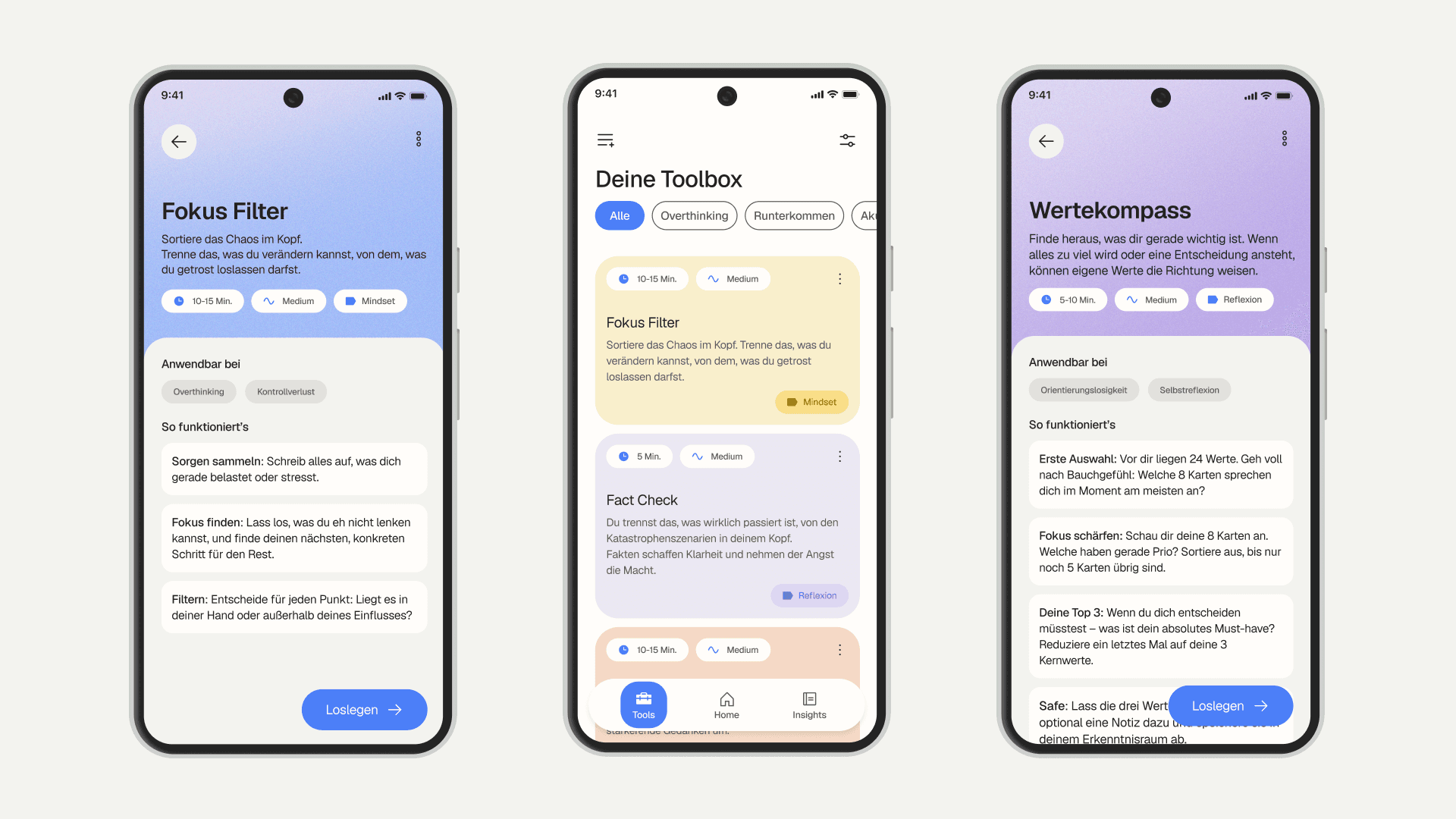
Heplful exercises and strategies can be saves and accessed anytime via the toolbox
Heplful exercises and strategies can be saves and accessed anytime via the toolbox

Tools can also be external activities
Tools can also be external activities
AI system design
AI system design
Besides the curated knowlede base Cope has an agent system to ensure interactions stay within the intended scope.
This acts as another safety mechanism, giving each agent a designated specialized task and doublechecking answers for problematic patters before they are sent to the user.
Besides the curated knowlede base Cope has an agent system to ensure interactions stay within the intended scope.
This acts as another safety mechanism, giving each agent a designated specialized task and doublechecking answers for problematic patters before they are sent to the user.

Flow diagram of output generating process

System diagram of Cope AI
Flow diagram of output generating process
System diagram of Cope AI
Clearly defined system boundaries
Clearly defined system boundaries
Built to foster coping skills for everyday anxieties, Cope operates within clear system boundaries. It explicitly avoids handling clinical conditions or emergencies.
Instead, the system recognizes boundaries early, transparently communicates its scope, and instantly routes users to professional help.
Built to foster coping skills for everyday anxieties, Cope operates within clear system boundaries. It explicitly avoids handling clinical conditions or emergencies.
Instead, the system recognizes boundaries early, transparently communicates its scope, and instantly routes users to professional help.

Simple redirection to external professional emergency services or people, activities and more
Simple redirection to external professional emergency services or people, activities and more
Communication
Communication
Cope presents a safer, empowering alternative to standard AI companion built specifically for young adults who want to foster self-reliance, emotional resilience, and healthy mental habits.
Cope presents a safer, empowering alternative to standard AI companion built specifically for young adults who want to foster self-reliance, emotional resilience, and healthy mental habits.

Cope social media accounts foster dialogue through expert and user insights, while promoting safe AI practices beyond the Cope app.

Landing page giving transparent insight into how cope works

OOH campaign focusing on everyday anxiety awareness
Cope social media accounts foster dialogue through expert and user insights, while promoting safe AI practices beyond the Cope app.
Landing page giving transparent insight into how cope works
OOH campaign focusing on everyday anxiety awareness
Conclusion
Conclusion

Exhibiting Cope
Exhibiting Cope at the HfG Schwäbisch Gmünd semester showcase highlighted the urgent need for conscious AI interaction design that actively resists dangerous patterns.
Building a validated, research-backed proof of concept required navigating deep psychological frameworks and complex AI system logic.
While challenging, this thesis yielded a scalable concept and actionable design principles for emotional, human-centered AI interaction.
Exhibiting Cope
Exhibiting Cope at the HfG Schwäbisch Gmünd semester showcase highlighted the urgent need for conscious AI interaction design that actively resists dangerous patterns.
Building a validated, research-backed proof of concept required navigating deep psychological frameworks and complex AI system logic.
While challenging, this thesis yielded a scalable concept and actionable design principles for emotional, human-centered AI interaction.